
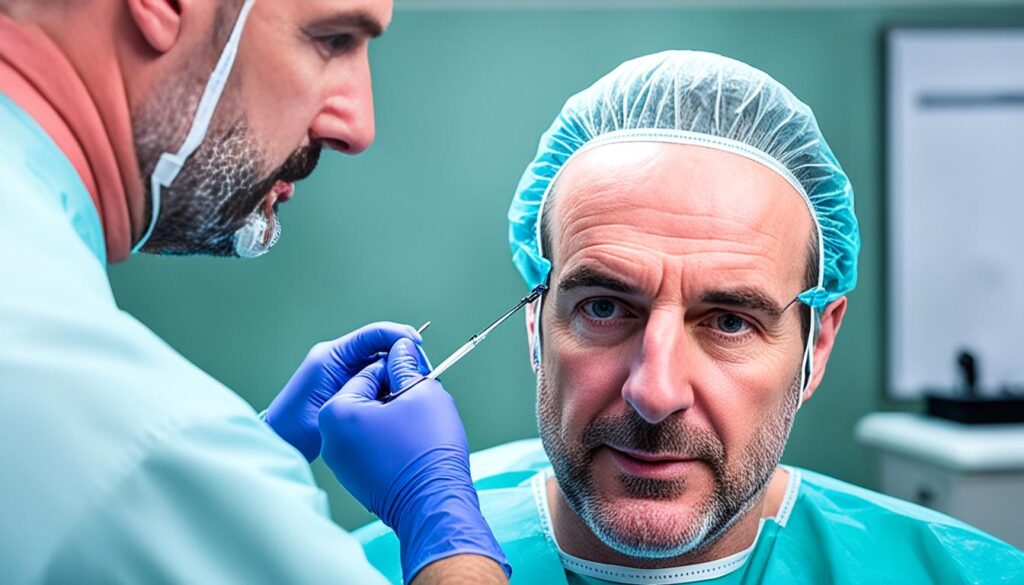
FUT, or follicular unit transplantation, is a hair transplant technique that offers effective hair restoration for individuals experiencing hair loss. This procedure involves the removal of a strip of skin from the donor area on the scalp, which is then carefully dissected under a microscope to extract individual hair follicle units. These units are then transplanted into the recipient area, resulting in natural-looking hair growth and thickening.
When considering a FUT hair transplant, it is essential to consult with a skilled and experienced surgeon, such as Dr. Munir Somji, who specializes in this technique. During a consultation, Dr. Somji assesses the patient’s suitability for treatment and discusses their desired outcomes.
The FUT procedure involves the removal of the donor strip, meticulous graft selection, and precise placement of the follicular units in the recipient area. The entire process is performed under local anesthesia, ensuring a painless experience for the patient. The duration of the procedure can vary depending on the size of the treatment area and the number of grafts being transplanted.
After the FUT hair transplant, patients can expect to see noticeable results as early as 4 months following the procedure. Continual hair growth and thickening occur in the months that follow, providing patients with natural-looking and long-lasting results.
Key Takeaways:
- FUT, or follicular unit transplantation, is a hair transplant technique for hair restoration.
- The procedure involves the removal of a strip of skin from the scalp and the transplantation of individual hair follicle units.
- Dr. Munir Somji is an experienced surgeon specializing in FUT hair transplant techniques.
- The procedure is painless and performed under local anesthesia.
- Visible results can be seen as early as 4 months after the procedure, with continued hair growth and thickening over time.
What is a FUT Transplant?
FUT, or follicular unit transplantation, is a hair transplant technique used to address bald spots caused by hair loss. This procedure involves the removal of a strip of skin from the back or side of the head, which contains healthy hair follicles. These follicles are then meticulously inserted into the areas of the scalp that suffer from balding.
FUT is particularly effective in treating receding hairlines commonly associated with male pattern baldness. The surgery typically lasts between 4 and 8 hours, and local anesthesia is used to numb the scalp during the procedure.
Results from FUT surgery are not immediate, as it takes time for the transplanted hair follicles to grow. Patients can expect to see visible improvements in 6 to 9 months, with continued growth and thickening of the hair over time.
| Pros of FUT Transplant | Cons of FUT Transplant |
|---|---|
|
|
How does the FUT Transplant Procedure Work?
The FUT transplant procedure involves several steps:
- The surgeon harvests a strip of skin from the donor area on the scalp.
- The strip is carefully dissected under a microscope to extract individual hair follicles.
- The surgeon makes small incisions in the recipient area and inserts the follicular units.
- The transplanted hair follicles gradually grow and integrate into the surrounding scalp, promoting natural-looking hair growth.
“FUT transplant is a time-tested method for restoring hair and addressing bald spots. The procedure offers the advantage of allowing the transplantation of a larger number of grafts, making it an ideal choice for patients with more extensive hair loss.”
How does FUT work?
During FUT surgery, a strip of skin is carefully harvested from the scalp, typically from the back or side of the head, where the hair is usually thicker and less prone to balding. This strip contains healthy hair follicles that will be used as grafts to restore hair in areas affected by hair loss.
The harvested strip is then meticulously dissected under a microscope to extract individual follicular units. These follicular units, which can consist of 1 to 4 hairs, are the building blocks for the transplantation process.
Once the follicular units have been prepared, the surgeon creates small incisions in the recipient area of the scalp. These incisions serve as the sites where the follicular units will be inserted. The angle, direction, and density of the transplanted hair are carefully determined to ensure a natural and aesthetically pleasing result.
Using minuscule forceps, the surgeon delicately inserts the extracted follicular units into the incisions, paying close attention to achieve proper placement and alignment. This meticulous technique is crucial in achieving a natural hair growth pattern and avoiding any visible signs of the transplant procedure.
FUT surgery is a specialized procedure that requires the expertise of a skilled surgeon to ensure optimal results. By following this detailed process, FUT effectively restores hair in areas affected by hair loss, providing patients with long-lasting and natural-looking hair regrowth.
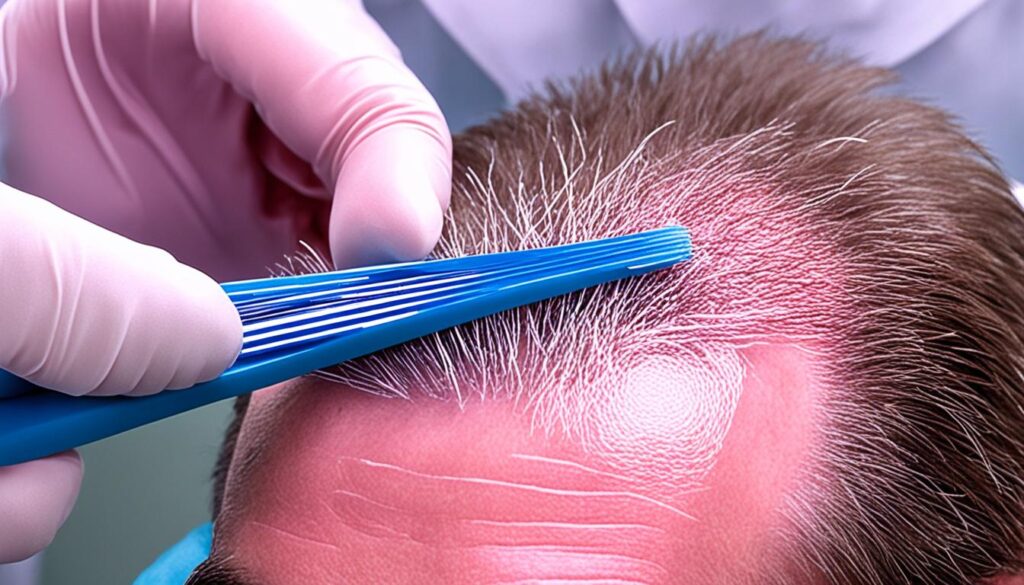

Detailed Step-by-Step Process of FUT Hair Transplant:
- Harvesting of a strip of skin from the donor area (usually the back or side of the head).
- Dissection of the harvested strip to extract individual follicular units.
- Creation of small incisions in the recipient area.
- Placement of the extracted follicular units into the incisions using minuscule forceps.
FUT vs. FUE Hair Transplant
When considering hair transplant methods, two popular options to choose from are FUT (follicular unit transplantation) and FUE (follicular unit extraction). Each technique has its own unique benefits and considerations.
FUT involves removing a strip of skin from the scalp, typically from the back or side of the head. This strip contains healthy hair follicles that will be used for transplantation. On the other hand, FUE involves extracting individual follicular units directly from the scalp, without the need for strip harvesting.
One advantage of FUT is its speed and cost-effectiveness. The procedure allows for the transplantation of a larger number of grafts, making it particularly suitable for patients who require significant hair restoration. Additionally, FUT can achieve excellent results in a shorter timeframe.
FUE, on the other hand, is less invasive and does not result in a linear scar like FUT. This makes it an ideal option for patients who prefer to wear their hair very short. The extraction of individual follicular units allows for precise placement and natural-looking results.
The choice between FUT and FUE ultimately depends on the patient’s specific needs and preferences. It is important to consult with a qualified hair transplant surgeon to determine the most suitable technique for achieving desired outcomes.

Advancements in FUT Hair Transplant
Over the years, there have been significant advancements in FUT hair transplant techniques, making the procedure more effective and accessible to a wider range of patients. These advancements have revolutionized the field of hair restoration and have improved the overall outcomes of FUT surgeries.
The FOX Procedure: Intact Follicular Unit Extraction
One notable advancement in FUT hair transplant methods is the introduction of the FOX procedure, also known as FUE or follicular unit extraction. This technique allows for the extraction of intact follicular units without the need for strip harvesting.
The FOX procedure has several advantages over traditional FUT methods. It offers the potential to achieve more than a thousand grafts in a single day, making it a faster and more efficient option for patients seeking hair transplant surgery. The procedure involves the extraction of individual follicular units directly from the scalp, preserving their integrity and viability. This results in improved graft survival rates and natural-looking hair growth.
The FOX procedure has gained popularity due to its ability to minimize scarring and provide patients with a quicker recovery time compared to traditional FUT methods. The absence of a linear scar allows patients to style their hair in any way they desire without worrying about visible scars.
Improved Instrumentation and Surgical Techniques
Advancements in instrumentation and surgical techniques have also contributed to the effectiveness of FUT hair transplant procedures. Surgeons now have access to more precise and specialized tools that enable them to perform the surgery with increased accuracy and efficiency.
“With improved instrumentation and surgical techniques, we are able to ensure better outcomes and reduced transection rates during FUT procedures,” says Dr. Munir Somji, a renowned hair transplant surgeon.
The use of advanced microscopes and microscopic dissection tools allows surgeons to carefully select and prepare the follicular units for transplantation. This ensures the highest quality grafts are used, resulting in optimal hair growth and a natural appearance.
The FOX Test: Evaluating Graft Extraction Suitability
In addition to the FOX procedure itself, the use of the FOX test has become an integral part of FUT hair transplant procedures. The FOX test evaluates the ease and completeness of graft extraction, helping surgeons determine the suitability of a patient for the FUE technique.
By performing the FOX test, surgeons can assess the scalp’s donor capacity and identify areas with the highest density of healthy hair follicles. This information allows them to customize the treatment plan and achieve the best possible results for each individual patient.
| Advancements | Benefits |
|---|---|
| The FOX Procedure | – Intact follicular unit extraction – More than a thousand grafts in a single day – Minimal scarring and quick recovery time |
| Improved Instrumentation and Surgical Techniques | – Better outcomes and reduced transection rates – Precise graft selection and preparation |
| The FOX Test | – Evaluate graft extraction suitability – Customize treatment plan for optimal results |
Thanks to these advancements, FUT hair transplant procedures have become a highly effective and reliable solution for patients seeking hair restoration. By consulting with a qualified hair transplant surgeon, patients can benefit from these advancements and achieve natural-looking hair growth.

Conclusion
When it comes to achieving natural-looking hair restoration, FUT, or follicular unit transplantation, stands as a proven and effective hair transplant method. Our skilled surgeon, Dr. Munir Somji, brings years of experience in performing FUT procedures, ensuring the best possible outcomes for our patients. While alternative options like FUE exist, FUT remains a popular choice for individuals seeking a significant amount of hair transplantation.
Advancements in FUT techniques, such as the FOX procedure and improved instrumentation, have enhanced the effectiveness and accessibility of this procedure. The FOX procedure, a form of FUE, allows for the extraction of intact follicular units without the need for strip harvesting, enabling the transplantation of more than a thousand grafts in a single day. These innovations have made FUT a viable choice for a more extensive range of patients.
When deciding on the best hair transplant method, it is crucial to consult with a qualified and experienced surgeon. Dr. Munir Somji, as a leading hair transplant surgeon, possesses the expertise necessary to assess individual needs and desired outcomes, determining the most suitable approach. Whether it is FUT or FUE, our goal is to provide patients with natural-looking hair restoration that boosts their confidence and quality of life.
FAQ
What are FUT hair transplant methods?
FUT, or follicular unit transplantation, is a hair transplant technique that involves the removal of a strip of skin from the donor area on the scalp. This strip is then carefully dissected under a microscope to harvest individual hair follicle units, which are transplanted into the recipient area.
How does a FUT transplant work?
During a FUT transplant, a strip of skin is removed from the scalp, usually from the back or side of the head, which contains healthy hair follicles. This strip is then dissected to extract individual follicular units, which are transplanted into the recipient area of the scalp.
What is the difference between FUT and FUE hair transplant?
FUT involves the removal of a strip of skin from the scalp, while FUE involves the extraction of individual follicular units directly from the scalp. FUT is faster, more cost-effective, and allows for the transplantation of a larger number of grafts. On the other hand, FUE is less invasive, does not result in a linear scar, and is ideal for patients who want to wear their hair very short.
What advancements have been made in FUT hair transplant techniques?
Advancements in FUT hair transplant techniques include the introduction of the FOX procedure, which allows for the extraction of intact follicular units without strip harvesting. Improved instrumentation and surgical techniques have also led to better outcomes and reduced transection rates. These advancements have made FUT hair transplant procedures more effective and accessible to a wider range of patients.
What results can I expect from a FUT hair transplant?
Results from a FUT hair transplant can be seen as early as 4 months after the treatment, with continued hair growth and thickening over the following months. It is important to consult with a qualified hair transplant surgeon, such as Dr. Munir Somji, to discuss your specific needs and desired outcomes.