
Did you know that hair loss affects approximately 50 million men and 30 million women in the United States alone?
However, there is a glimmer of hope on the horizon. Thanks to groundbreaking research at Rensselaer Polytechnic Institute, bioprinting hair follicles has become a reality, bringing science fiction to life. This innovative technique, achieved through the use of 3D printing technology, holds immense potential for the future of hair growth solutions and marks a significant milestone in regenerative medicine.
Under the leadership of Dr. Pankaj Karande, the research team has successfully bioprinted hair follicles in lab-grown human skin tissue. Their work, published in the journal Science Advances, showcases the remarkable progress in tissue engineering and highlights the potential of 3D bioprinting in the field of skin restoration. By overcoming the historical challenge of reconstructing hair follicles using human-derived cells, this breakthrough offers hope for advanced hair restoration and improved treatments for hair loss.
Key Takeaways:
- Bioprinting hair follicles offers a promising solution for hair loss, affecting millions of people worldwide.
- This innovative technique bridges the gap between science fiction and reality through the use of 3D printing technology.
- The breakthrough in bioprinting hair follicles paves the way for advanced hair restoration and improved treatments for hair loss.
- Further advancements in bioprinting technology and tissue engineering hold great potential for the development of fully functional skin with hair.
- The integration of bioprinting into regenerative medicine practices opens exciting new opportunities for treatment approaches.
The Future of Bioprinted Hair Follicles
While the current models for skin engineering lack the complexity of hair follicles, the successful bioprinting of hair follicles opens up new possibilities for the future of regenerative medicine. The team at Rensselaer Polytechnic Institute envisions extending the lifespan of engineered tissues, allowing hair follicles to mature further and enabling applications in drug testing and skin grafts. This breakthrough technology could provide a deeper understanding of how skin interacts with topical products and lead to the development of more effective treatments for various skin conditions. Dr. Karande’s lab is at the forefront of skin tissue engineering, and their previous success in printing skin with working blood vessels demonstrates the immense potential of this field in enhancing human health. With continued advancements in bioprinting techniques and materials, the future of bioprinted hair follicles holds promise for advanced hair restoration and improved treatments for hair loss.
Advancements in 3D Bioprinting Technology
The successful bioprinting of hair follicles relies on advancements in 3D bioprinting technology. The researchers at Rensselaer Polytechnic Institute have made significant progress in adapting 3D-printing techniques to operate at the cellular level, bringing about groundbreaking developments in skin tissue engineering.
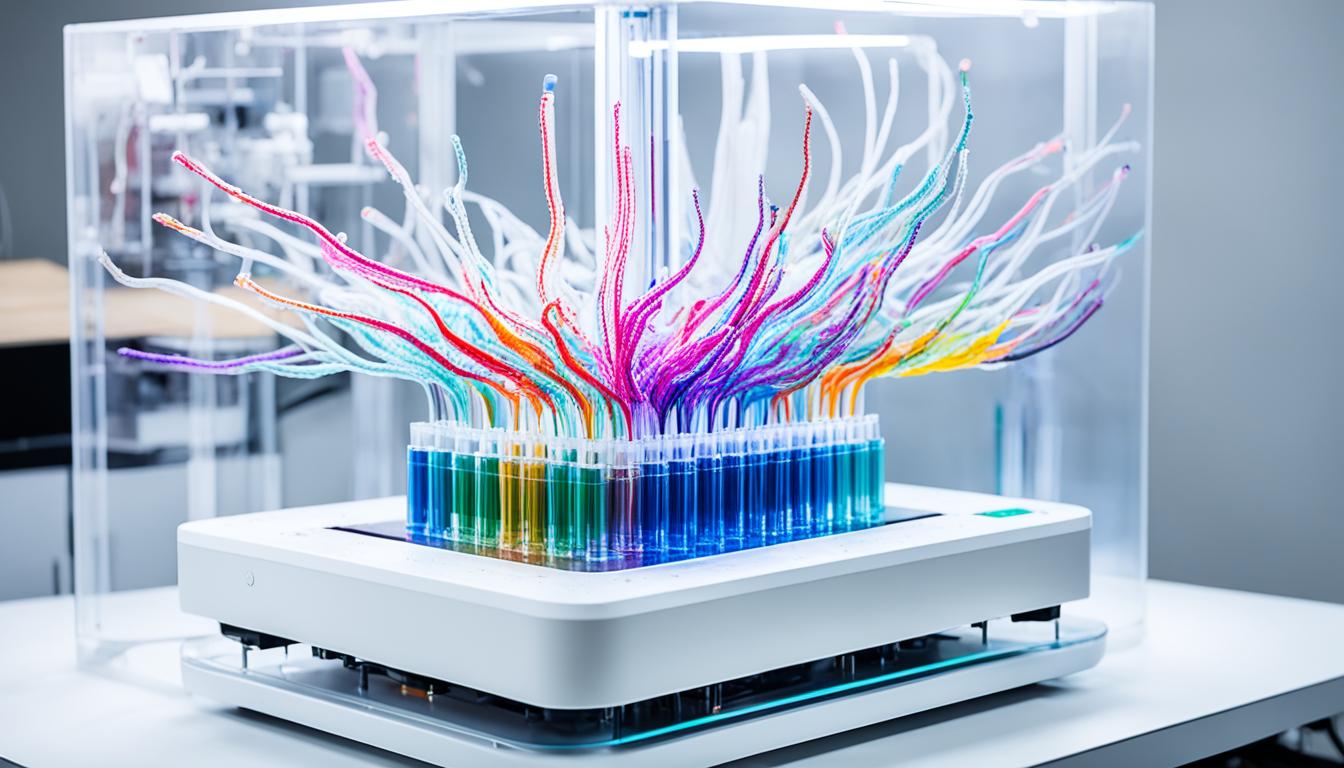
In the lab, skin and follicle cells are cultivated until a sufficient amount of printable cells is obtained. These cells are then combined with proteins to create a specialized “bio-ink” used by the printer. Using an extremely thin needle, the printer deposits the bio-ink layer by layer, creating intricate channels for hair cell deposition. As a result, the skin cells migrate to these channels, replicating the intricate structures of natural skin, including the complex follicle structures.
This process showcases the immense potential of 3D bioprinting technology in creating complex tissue structures with precision and reproducibility. By operating at the cellular level and leveraging bio-ink, researchers can accurately replicate the cellular composition and architecture of hair follicles, a significant accomplishment in the field of tissue engineering.
In addition to bio-ink, the use of tissue engineering scaffolds, hydrogels, and other synthetic materials plays a crucial role in 3D bioprinting. These materials provide a suitable 3D microenvironment for cell growth and regeneration, enabling the successful creation of intricate tissue structures.
“The successful bioprinting of hair follicles using 3D bioprinting technology represents a remarkable advancement in the field of regenerative medicine. This breakthrough opens up possibilities for advanced hair restoration, improved treatments for hair loss, and a deeper understanding of skin interactions.” – Dr. Pankaj Karande, Rensselaer Polytechnic Institute
With continued advancements in 3D bioprinting technology and the development of more sophisticated bio-inks and materials, the field of tissue engineering and regenerative medicine will continue to evolve. Researchers aim to expand the capabilities of 3D bioprinting, enabling the creation of fully functional skin with hair and unlocking new possibilities for the treatment of various skin conditions.
Advancements in 3D Bioprinting Technology:
| Advancement | Description |
|---|---|
| Bio-ink | The development of specialized bio-inks that combine cells and proteins, allowing for accurate replication of tissue structures. |
| Tissue Engineering Scaffolds | The use of scaffolds to provide structural support and guide cell growth in 3D bioprinting processes. |
| Hydrogels | Hydrogels act as a 3D microenvironment for cell growth and regeneration, facilitating tissue formation and development. |
| Synthetic Materials | The integration of synthetic materials to enhance the structural integrity and functionality of bioprinted tissues. |
As the field of 3D bioprinting technology continues to advance, the synthesis of these advancements will further enhance the capabilities of tissue engineering and regenerative medicine. With improved precision, reproducibility, and biocompatibility, 3D bioprinting holds immense potential to revolutionize the field and pave the way for new advancements in skin tissue engineering and other areas of regenerative medicine.
Conclusion
The successful bioprinting of hair follicles represents a significant advancement in the field of regenerative medicine. This innovative technique not only bridges the gap between sci-fi and reality but also has the potential to revolutionize the future of hair growth solutions. By harnessing the power of 3D printing technology and tissue engineering, researchers have overcome the historical challenges of reconstructing hair follicles using human-derived cells.
This breakthrough opens up new possibilities for advanced hair restoration, improved treatments for hair loss, and a deeper understanding of how skin interacts with topical products. With continued advancements in bioprinting technology and materials, the future holds great potential for the development of fully functional skin with hair and the further integration of bioprinting into regenerative medicine practices.
As the field continues to progress, exciting new opportunities and applications will arise, transforming the way we approach hair loss treatment and regenerative medicine as a whole. The journey from sci-fi to reality is well underway.
FAQ
What is bioprinting?
Bioprinting is a technique that uses 3D printing technology to create living tissues and organs by layering cells and bio-ink to build complex structures.
How does bioprinting hair follicles work?
Bioprinting hair follicles involves culturing skin and follicle cells, combining them with proteins to create bio-ink, and using a 3D printer to deposit the bio-ink layer by layer. The cells migrate to the printed channels, replicating the structures found in natural skin.
What are the potential applications of bioprinted hair follicles?
Bioprinted hair follicles have the potential for advanced hair restoration, improved treatments for hair loss, and a deeper understanding of how skin interacts with topical products. They could also be used in drug testing and skin grafts.
How does 3D bioprinting technology benefit tissue engineering?
3D bioprinting technology enables the creation of complex tissue structures with precision and reproducibility. It provides a suitable 3D microenvironment for cell growth and regeneration, revolutionizing the field of tissue engineering and regenerative medicine.
What does this breakthrough mean for the future of regenerative medicine?
The successful bioprinting of hair follicles represents a significant advancement in regenerative medicine. It opens up new possibilities for the development of fully functional skin with hair and the integration of bioprinting into advanced hair restoration and other regenerative medicine practices.
1 thought on “Bioprinting Hair Follicles: Sci-Fi Becomes Reality”